Navigation Guided Surgeries
Navigation guided surgery is an advanced surgical technique that uses specialized computer-assisted technology and patient-specific imaging to help the surgeon accurately locate and remove tumors. It provides real-time guidance during surgery and can be particularly useful for complex tumors located near important nerves, blood vessels or joints.
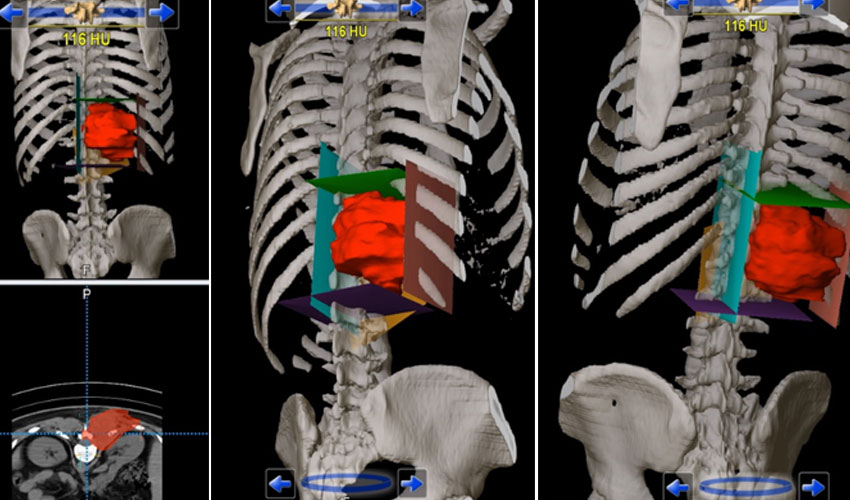
Understanding
Computer-Assisted Surgical Navigation
- Navigation systems use pre-operative CT or MRI imaging to create a detailed three-dimensional representation of the patient's anatomy.
- The technology helps the surgeon identify the exact location and boundaries of a tumor during the procedure.
- It can be especially valuable in anatomically complex areas where precise tumor removal and preservation of healthy structures are important.
- Navigation may assist in achieving accurate surgical margins while supporting preservation of important bones, joints and surrounding tissues.
Applications
Precision in Complex Tumor Surgery
- Navigation can be used for selected bone and soft tissue tumor surgeries where accurate three-dimensional localization is required.
- It may assist with complex resections and reconstruction procedures involving the pelvis, spine or other challenging anatomical regions.
- Patient-specific imaging and surgical planning help determine the optimal approach before the procedure.
- Real-time guidance can support precise execution of the planned surgical procedure.
Treatment
Navigation guided surgery is planned according to the tumor type, location, size and relationship with surrounding structures. The surgical plan is developed using detailed imaging and may be combined with patient-specific instruments, 3D planning or customized reconstruction techniques when appropriate. The aim is to achieve accurate tumor removal while preserving as much healthy tissue and function as possible.